FRANK HENRY NETTER, M.D.

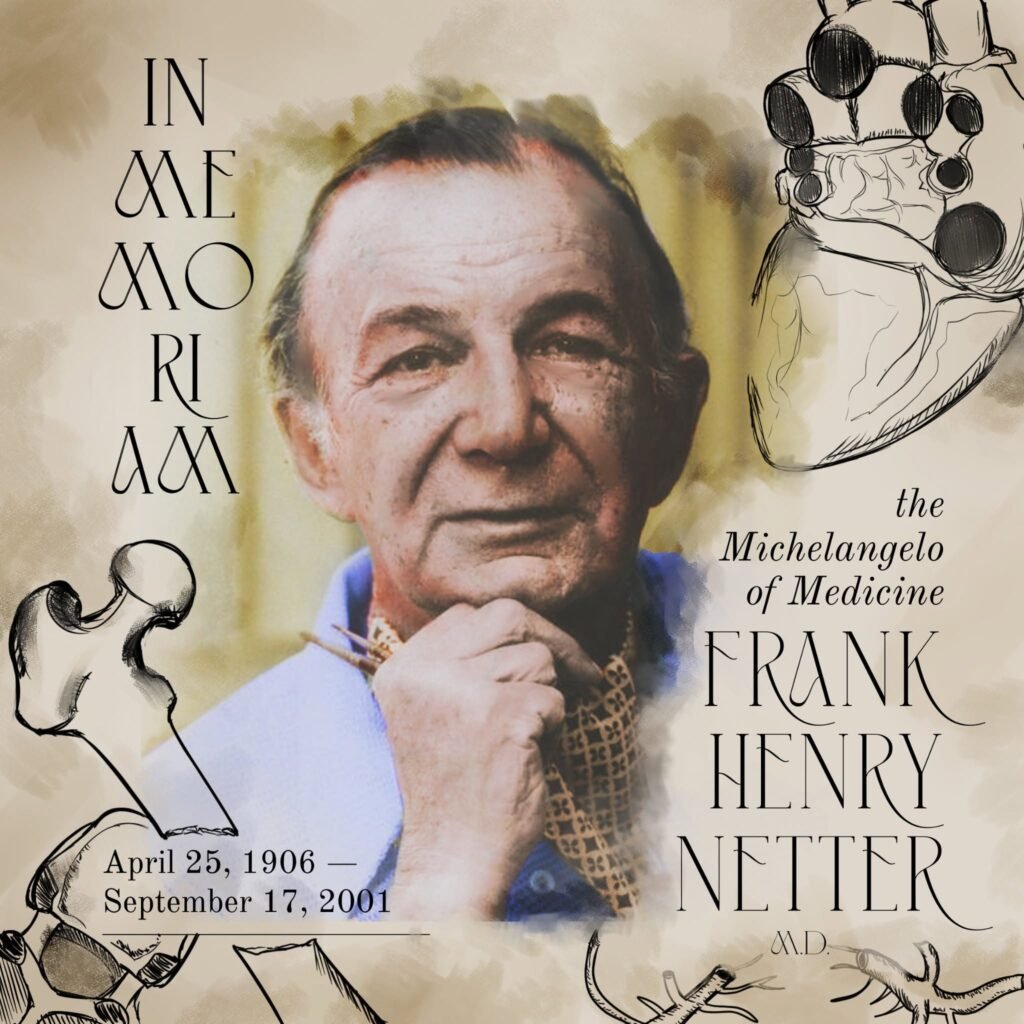
The Medical Michelangelo
April 25, 1906 – September 17, 1991
It was 1933. The Great Depression saw even doctors go hungry. To augment his meager wages as a physician, Frank Henry Netter painted gouache illustrations of hearts, organs, and pathologies to sell to drug companies. He only entered medical school because his mother Esther—a hard-nosed immigrant—discouraged him from taking his true passion: artistry. Yet nearly a century later, when fresh-faced MD hopefuls first learn to see the world through the eyes of a doctor, whose works are likeliest to start illuminating their sight than Dr. Netter’s?
Credited with producing as many as 4,000 medical illustrations in his lifetime, Netter was—and still is—regarded as the most prolific artist of the human body in medicine to date. His masterwork, the Atlas of Human Anatomy, collected 70 years of art depicting the beauty of the human organism and the conditions that plague it. Throughout his career, he painted not only the timelessness of the human form but the advent of organ transplants, joint replacements, and revolutionary surgeries.
Purists nowadays would say Netter’s works are simplistic—but this misses the point. Netter simply married clinical detail to compassionate storytelling—every art plate of disease showing the patient as human rather than a case. Subjects grimaced or frowned, kids cried, and the sick looked tired, worried, afraid. He painted past the mess of the human body and captured what was necessary. Without words, Netter subtly impressed upon students how medicine was as much the art of humanism as it was the science of healing.
Today, on the 34th anniversary of his death, we celebrate Dr. Netter as a legendary figure in medical education and an exemplar of cultivating one’s passions through and beyond doctorship.
LCM || Wynzel Desuyo